
Sunday Special: The Caracas Restructuring & 10 Stocks for the New Energy Era

On January 3, 2026, the global energy map was redrawn in a single night. Operation Absolute Resolve—the capture of Nicolás Maduro—wasn’t just a regime change; it was the start of The Caracas Restructuring. By activating the “Donroe Doctrine,” the U.S. has effectively secured the world’s largest oil reserves, ending decades of volatility and shifting the balance of power back to the Western Hemisphere.
This move does two things: it guarantees a long-term “oil ceiling” that defunds hostile regimes, and it launches the most significant infrastructure rebuild of the century.
The Oil Power Shift: Reserves vs. Reality
The primary reason Venezuela is a “prize” is its geological wealth. However, there is a massive gap between reserves (what is in the ground) and production (what can be sold today).
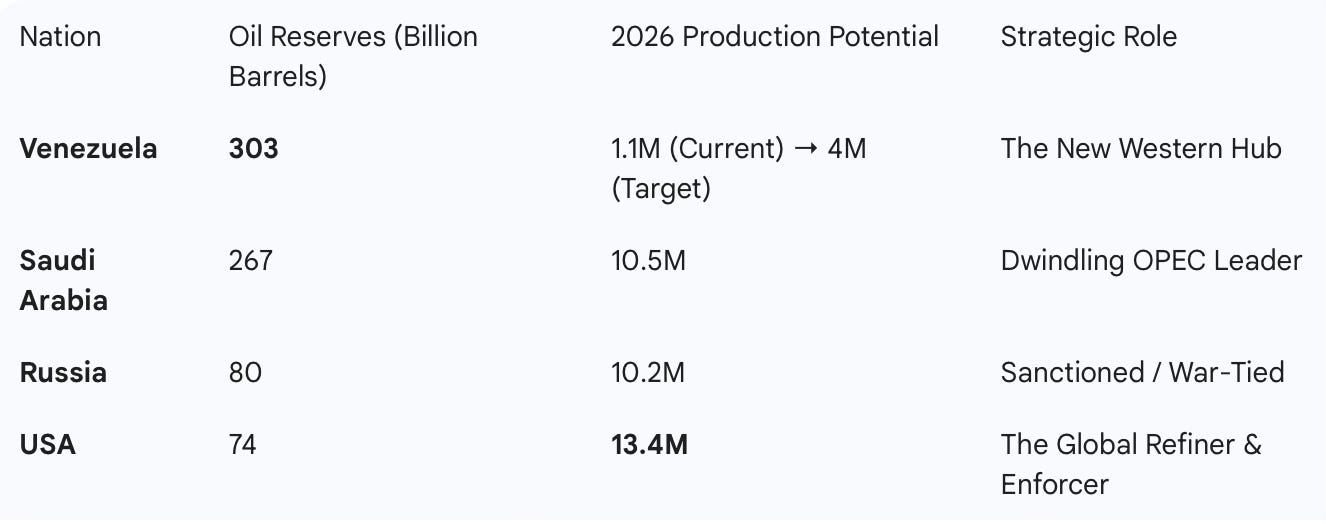
The Effect on Oil Prices: Immediately, oil prices have remained relatively stable (around $61/bbl) because traders know Venezuela's infrastructure is decayed. It will take tens of billions of dollars and nearly a decade for Western oil majors to return Venezuela to its 3-million-bpd glory days.
Long-term, however, this is bearish for oil prices. As "quarantined" Venezuelan crude returns to U.S. Gulf Coast refineries, global supply will swell, likely capping any price spikes for the next 24 months.
We are tracking 10 specific names positioned to dominate this new macroeconomic landscape. Not only oil names that will greatly benefit from this “takeover” but also infrastructure and transportation companies.
But before we get into the details of individual stocks and ETFs we’re looking at, let’s look into more geopolitical outcomes of the recent events in Venezuela.
Message to the Dictators
Beyond economics, the sheer speed and impunity of the Maduro arrest has sent a chilling psychological message to autocratic leaders globally, particularly in Iran.
The New Reality: Tehran now sees that traditional concepts of “sovereignty” are no longer a shield if a leader is designated a tier-one security threat by Washington. The swift decapitation of the Maduro regime proves that the U.S. has the capability and will to act unilaterally in its hemisphere. This creates a massive deterrent against Iranian aggression in the Middle East, as they realize they could be next on the target list if they cross red lines.
The primary beneficiary of a stabilized Venezuela is the global consumer, but the primary “victims” are the regimes that rely on high oil prices to fund their ambitions.
1. Defunding the Kremlin’s War Machine
Russia is essentially a “gas station with nukes.” For years, Vladimir Putin has funded his war in Ukraine using high oil prices and “shadow fleet” exports. The return of Venezuelan heavy crude to U.S. refineries is Putin’s worst nightmare.
The Squeeze: As of early 2026, Russian Urals crude is already facing steep discounts. If U.S.-led investment brings even 1 million extra barrels per day (bpd) from Venezuela to the global market, Brent prices could drop toward $45–$50/bbl.
The Result: At $45/bbl, Russia cannot balance its budget. This creates internal pressure on the Kremlin, potentially forcing a choice between domestic stability and continued military spending in Ukraine.
2. China: Losing the “Sanctioned Oil” Loophole
China has been the biggest buyer of “illicit” Venezuelan oil, often transacted through “teapot” refiners to avoid U.S. sanctions.
The Shift: With the U.S. now “running” the transition, that loophole is closed. China must now buy oil on the open market or negotiate directly with a U.S.-backed Caracas. This removes a key strategic lever China held in Latin America and increases their energy import costs.
3. Saudi Arabia & OPEC+: The Loss of Leverage
Saudi Arabia’s Vision 2030 requires oil at $80+/bbl to stay on track.
The Threat: Venezuela has more oil than Saudi Arabia (303B vs 267B barrels). Historically, Saudi Arabia controlled the world by being the “swing producer.” If the U.S. controls Venezuelan production, OPEC+ loses its ability to “blackmail” the West with production cuts.
The Investor Playbook: Trading the Transition
The market is now pricing in two realities: lower long-term energy costs and a massive infrastructure boom.
We have identified 10 stocks and ETFs that are uniquely positioned to profit from cheaper fuel, massive infrastructure contracts, and the “space-first” rebuilding of a collapsed nation.
